
You're buying the home but renting the ground. Here's what to read, ask and check before you sign a park lease in Las Vegas.
You own the home. The park owns the ground.
This is the fundamental thing about park living, and it surprises people who assume 'mobile home park' means renting. You own the home outright, or you finance it like any other purchase. What you don't own is the land under it. You lease that lot, month to month or on a longer lease, and you pay lot rent for it.
That arrangement works well for a lot of people: lower entry cost, no responsibility for the land, and often utilities and amenities included. But it means you're in a long-term relationship with a business, and you should understand the terms of that relationship before you sign.
Get the lot rent in writing, and ask about increases
Lot rent is your largest recurring cost after any loan payment, and it can be higher than people expect. Ask the park for the current figure in writing, and ask what it has done historically and what the lease says about future increases.
Nevada law and local ordinances affect what parks can do, and the specifics can change. What binds you is the lease and the park's written rules, so read those rather than relying on a conversation at the office or something you read online. If a manager tells you rent won't go up, ask to see where that's written down.
- Current lot rent, in writing
- What the lot rent covers, water, sewer, trash, amenities
- The lease term and how increases are handled
- Any application, transfer or background-check fees
Read the rules before you fall in love with the home
Park rules typically cover pets (including breed and weight limits), vehicles and parking, exterior modifications, decks and sheds, guest stays, lawn care, and how disputes are handled. Some parks are relaxed. Others are strict about the color of your skirting.
Neither is wrong, but you need to know which one you're moving into. If you have two large dogs, a project car, or plans to build a shed, find that out before you buy, not after.
The approval process is real
Most parks screen applicants with a credit check, background check and proof of income, plus an application fee that's usually non-refundable. It's a normal part of park living and not something to take personally.
What you can control is preparation. A complete application with clear income documentation moves faster than a patchy one. If you know there's something in your history that a park might question, address it directly rather than hoping it goes unnoticed, that's almost always the better outcome.
And if one park says no, that's one park's decision. Standards differ. A denial isn't a verdict on you.
Ask about the park itself, not just the space
Who manages it, and how long have they been there? Is it owned by a resident-focused operator or a large investment group? How quickly are maintenance issues handled? Is there a residents' association? What's the condition of the common areas, the clubhouse, the pool, the roads?
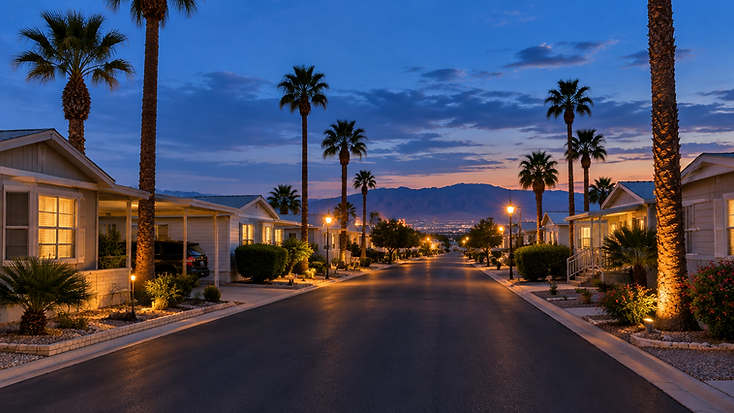
Drive through in the evening, not just at midday. You'll learn more about noise, parking, and general upkeep from ten minutes at 7 p.m. than from any brochure.
Selling later
When you eventually sell, the park will need to approve your buyer too, the same process you went through. That's worth knowing because it affects how long a future sale takes. It's not a reason to avoid a park; it's a reason to keep your paperwork in order and to stay on good terms with the office.
Keep your title, your lease and your HUD label documentation together from day one. Future you will be grateful.
Questions about your own situation?
Alex answers his own phone, open 24/7. No pressure, no obligation, just a straight answer about buying or selling a mobile home in Las Vegas.
Call (727) 580-4800